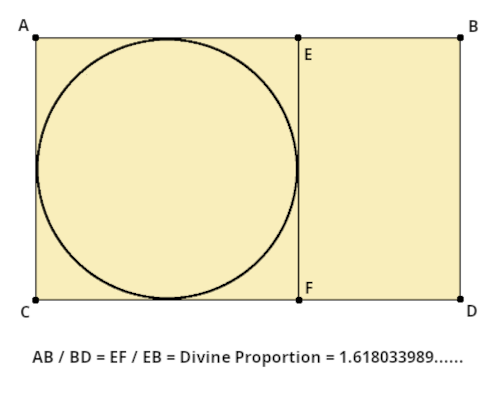
The proportion is sometimes used by architects to design buildings, often buildings with a religious purpose, thus the "divine proportion." In other contexts it is also known as the "golden ratio." The purpose of using the ratio in architecture appears to be entirely symbolic or artistic. It could indicate a relationship between the "godly" and the "less than godly" or perhaps the "divine" and the "human" or perhaps the "above" and the "below."
A reason the proportion could be less popular lately is that it can appear to support some sort of "inequality" and these days "equality" is the more important relationship. That can be a serious misinterpretation of equality though. Equality is usually supposed for everyone "under the law" or everyone who abides by the laws. Anyone who breaks the laws can have their rights limited. If their crimes are serious enough they might even be confined.
Especially since the foundation of the United States and after the Civil War "equality under the law" is an extremely important value. It can still be important even these days to realize that it requires following some sort of rules. The "godly" and the "ungodly" might not be equal if the "ungodly" have violated the rights of their neighbors.
Confusion can result when people assume that everything must be equal. There is an effort to make the political parties equal and to make the political parties represent every possibility. A mistake often made with freedom of speech is believing that because every idea may be discussed then every idea must be valuable. The reality of course is that some ideas are so terrible that it is not necessary to waste time on them. For several election cycles recently the votes for both parties have been nearly equal and some people believe that is good. It is not good. If everything under the sun is equally important, than nothing is important. Trying to govern using that relationship is not working. In order to decide on the "legality" of something there needs to be a much more clear majority.
So total equality on everything under the sun is not working, but another relationship that is not working is 100 to nothing. If the "ungodly" count for zero, that can result in unnecessary deaths. It is not usually necessary to kill people for breaking laws, not most laws anyway. It can even be possible to teach people proper strategies to obtain their goals so that they no longer depend on illegal strategies.
What we have between those two extremes of everything being equal and all or nothing is the "divine proportion" whereby the "sinner" or the "ungodly" or the "mere human" is not equal to any god or to or its devout followers, but is still more important than nothing.
When you see a speed limit sign you know that is the same limit for all people no matter what their skin color, and no matter whether they are a male or a female. Police who fail to apply the law evenly are mistaken. Some people paid a dear price to end slavery and the inequality implicit in it. In order to ensure equality the rather crude means of quotas are often used, but some quotas do not make much sense. Although men and women are usually considered equal when abiding by the law, quotas for military service or child custody would be considered inappropriate. A reason the "ERA" or equal rights amendment for women failed is likely confusion over the use of such crude quotas to ensure any equality.
Complicated as it can indeed get, equality of treatment by the law is among the most important values in the United States. It took considerable effort for everyone to understand that subjugation based on skin color or whether a person is male or female is not productive.
While it is important to remember the equality of treatment by the law that still takes so much effort to ensure, it is also important to appreciate that there are such things as bad ideas. Not every government policy is going to advance society. Much more importantly there are people who for whatever reasons choose not to follow sound rules. They thereby relinquish their equality. There is a an expression, "It's all good," but it is not really all good. It is essential to find the good ideas and promote them with clear majorities.
A much more important and still timely interpretation of the proportion involves the fact that the smaller rectangle is an "image" of the larger one, the smaller one looks like the larger one, being of the same proportion. The smaller rectangle can represent good kids who do what their parents tell them. It can represent kids who are like their parents in that way. It can represent Jesus who came to help people obey God the Father. It can represent good adults who emulate God the Father.